
.svg)
Who Can Diagnose and Prescribe ADHD Medication in Australia?

In short: your GP is the starting point. A psychologist can assess you but cannot prescribe. In most of Australia a psychiatrist or paediatrician still diagnoses ADHD and starts medication, though some states now allow certain GPs to do more. Before you book anything, ask who will diagnose, who will prescribe, and who manages your treatment long term.
If you have spent any time reading Australian ADHD forums lately, you will have noticed the same question asked over and over, in slightly different words: who am I actually supposed to see?
Start with the GP, someone says. No — you need a psychiatrist. No — a psychologist can diagnose you. Actually, my GP prescribes mine. That depends what state you’re in. My assessment cost four figures and I still don’t have a script.
All of that can be true at the same time, which is exactly what makes it so hard to act on. The rules genuinely do differ depending on where you live, what age you are, whether you already have a diagnosis, and which specific clinician you end up in front of. And they have been changing quickly.
The four things people mix up
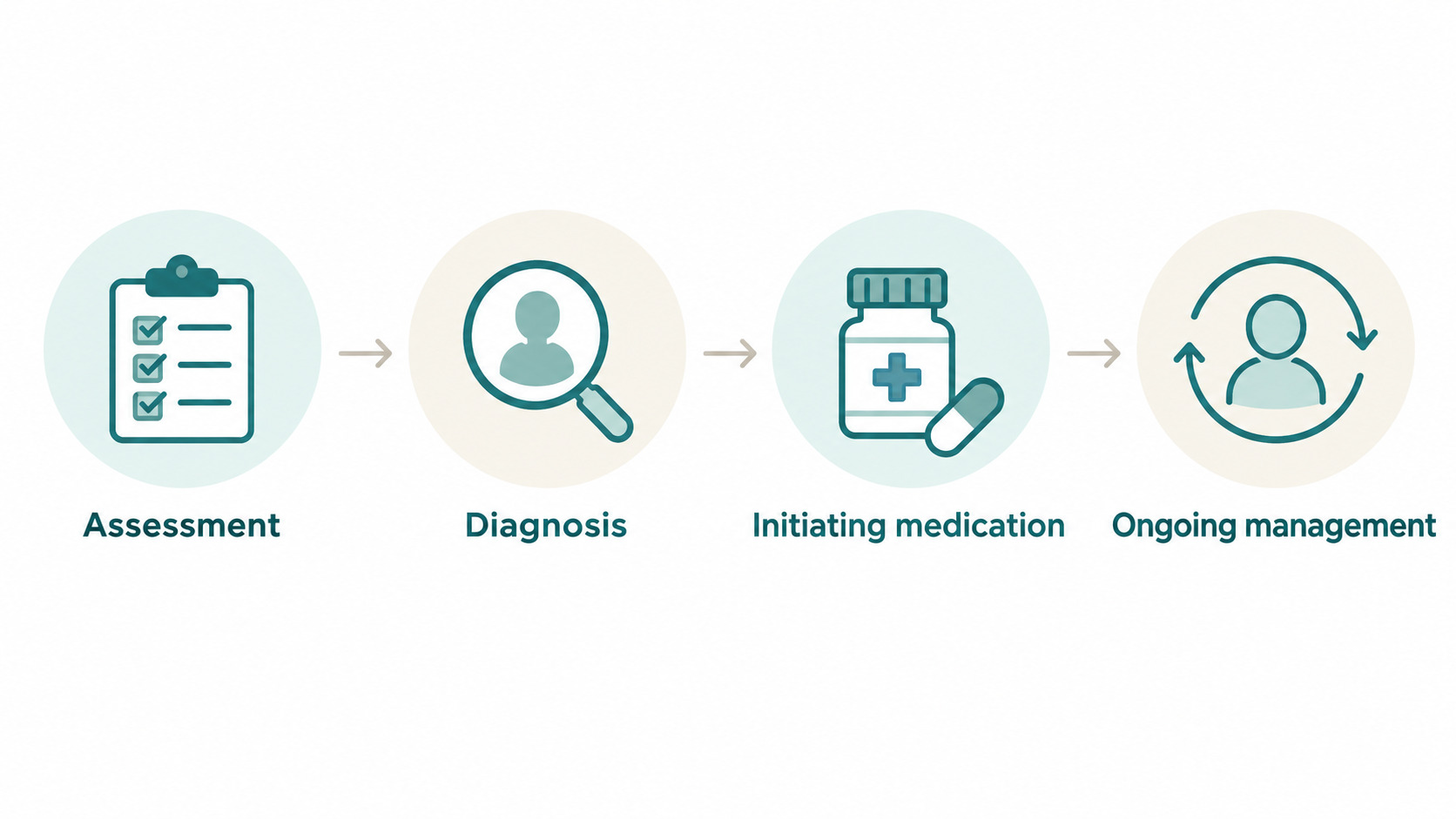
Most of the confusion comes from treating “getting ADHD sorted” as one event. It is actually four separate functions, and different clinicians are allowed to do different ones.
1. Assessment. The structured process of gathering history, rating scales, collateral information from family or school reports, and screening for other conditions that can look similar or occur alongside ADHD.
2. Diagnosis. The formal clinical determination that criteria are met.
3. Initiating medication. Writing the first prescription for a stimulant medication. In Australia these are Schedule 8 (S8) controlled medicines, and every state and territory regulates who may start them.
4. Ongoing management. Reviews, dose adjustments, repeat prescriptions, and monitoring over time.
The person who does step 1 is not always the person who can do step 3. This is the single most expensive misunderstanding in the whole pathway, and it is the reason people describe paying for a full assessment and then discovering they still cannot access treatment without seeing someone else.
How do you get an ADHD diagnosis in Australia?
For an adult, the sequence usually looks like this.
Step 1. See your GP. Talk through your concerns. Your GP can screen for other explanations, tell you whether a trained GP pathway exists in your state, and write a referral if specialist assessment is the right next step.
Step 2. Get assessed. This may be with a psychiatrist, a paediatrician, or in some states a trained GP. Expect questions about your history, your childhood, work or study, and any other mental health concerns.
Step 3. Discuss what happens next. If criteria are met, your doctor will talk through the options with you. Medication is one option among several, and it is not automatic.
Step 4. Agree who manages it from here. Settle this at the start rather than later. It determines who writes your prescriptions and how often you need appointments.
Who can diagnose ADHD, and who can prescribe?
Can a GP diagnose ADHD or prescribe for it?
Your GP is the entry point for almost everyone. They can discuss your concerns, screen for other explanations, order relevant tests, and write the referral you will need for a Medicare rebate on specialist care. In a growing number of states, appropriately trained GPs can now do considerably more than that — see the section below.
Can a psychologist diagnose ADHD?
A psychologist can conduct a detailed assessment and provide a comprehensive report. Psychologists cannot prescribe medication in Australia. A psychologist’s report can be valuable — for understanding your profile, for workplace or study adjustments, and as background for a treating doctor — but on its own it does not give you access to a prescription.
Do I need a neuropsychologist?
A neuropsychologist provides in-depth cognitive testing. This can be useful where the picture is complicated, but it is usually the most expensive option and is not a requirement for most straightforward adult presentations.
Who diagnoses ADHD in children?
A paediatrician typically leads diagnosis and prescribing for children and adolescents. In some states, including Queensland, trained or fellowed GPs can now do this for children as well.
What can a psychiatrist do that the others cannot?
A psychiatrist is a medical specialist who can assess, diagnose, initiate medication and manage treatment over time. That matters most when something else is going on alongside the ADHD. Anxiety, depression, trauma, substance use and bipolar disorder all change how it can be safely treated. In most of the country, psychiatrists remain the primary pathway for adults seeking a first-time diagnosis with medication as a possible outcome.
Why the answer depends on where you live
Until recently, the answer across most of Australia was simple and restrictive: a psychiatrist or paediatrician diagnosed ADHD and started medication, and they generally stayed involved indefinitely. Queensland was the long-standing exception, having allowed GPs to diagnose and prescribe for children since 2017.
That is changing. Since late 2025, states and territories have been progressively introducing pathways for GPs to take on more of this work. Most, but not all, require accredited additional training. The reforms have not landed everywhere at the same time or in the same form, and they generally roll out in stages:
· Continuation prescribing usually comes first. In most states a trained GP can maintain treatment that a specialist has already started, for a patient who is stable, without you needing to return to the specialist for every script.
· Diagnosis and initiation by trained GPs comes later, where it is available at all, and typically requires a further tier of training and formal endorsement.
· Queensland is the exception. Since 1 December 2025, fellowed specialist GPs there (FRACGP or FACRRM) have been able to diagnose adults and start medication without completing separate ADHD-specific training. Uptake is still limited and there is no public register of who is doing it.
Queensland and South Australia have moved furthest, and trained or fellowed GPs in those states can now diagnose adults and start treatment. New South Wales, the ACT and Western Australia sit at various points behind them. Victoria and Tasmania have both committed funding and begun training GPs, but at the time of writing their GPs still cannot diagnose ADHD or start medication independently. The Northern Territory has not announced reforms of this kind. Health ministers have also signalled an intention to work toward a more nationally consistent framework.
Two things trip people up:
“GPs can prescribe now” rarely means all GPs. In most states these authorities apply to individual doctors who have completed specific training and registered with their state health department. In Queensland it is tied to GP fellowship instead. Your regular GP may or may not be one of them, and some clinics choose not to offer the service even where their doctors are eligible. Ask your practice directly.
“Prescribe” does not always mean “diagnose and start.” A great deal of media coverage blurs continuation prescribing with initiation. They are different authorities.
Because these arrangements are being updated regularly, check the current position with your own state or territory health department rather than relying on a forum post, a news article or this page. Search for your health department’s medicines and poisons or ADHD prescribing pages for the authoritative version.
“I already have a psychologist’s report — what happens now?”
This comes up constantly, usually with real anxiety attached, because people are worried they have just spent a significant sum on something that will be disregarded.
A good-quality, recent report is rarely wasted. It is useful clinical background. But whether it is accepted — whether a treating doctor will rely on it rather than repeating parts of the assessment — is a clinical judgement made by the individual doctor, not a rule. It depends on how recent and detailed the report is, whether collateral history was included, whether other conditions were screened for, and what the doctor needs in order to prescribe safely.
So do not assume it will be accepted, and do not assume it will be ignored. Ask before you book:
“I have an assessment report from a psychologist dated [month/year]. Can I send it through before the appointment, and will it reduce what needs to be repeated?”
Most practices will tell you honestly, and it is a far better question than discovering the answer mid-consultation.
What it costs — and what to ask about fees
Cost is not a footnote in this pathway. It changes which route people take, and it is a common reason people stall halfway through.
Rather than quoting figures, it is more useful to know what to ask about, because the total is made up of more parts than most people expect:
· The initial assessment, which may be split across more than one appointment
· Any report fee, if you need documentation for work or study
· Follow-up and titration appointments while a dose is being adjusted
· Ongoing review appointments
· GP appointments alongside specialist care
· The medication itself
· What Medicare rebates apply, and to which of the above
Ask for a written fee schedule covering the whole expected pathway before you commit, not just the price of the first appointment. Any reputable practice will provide one.
It is worth knowing that specialist fees are set by each individual specialist, so they vary between clinicians even within the same service. Medicare rebates for psychiatric care generally require a valid referral, and different arrangements can apply depending on the item number, your location and the type of appointment — which is why it is always worth asking rather than assuming.
Questions to ask before you book
1. Who will make the diagnosis, and who will prescribe if medication is appropriate?
2. Will my existing reports be reviewed before the appointment?
3. What is the total expected cost across assessment, follow-up and reviews?
4. What Medicare rebates apply to each appointment?
5. Who manages my treatment long term — this clinician, or my GP?
6. If my GP takes over prescribing later, what do they need from you, and are they eligible in my state?
7. How long until I can be seen, and how soon after that is the follow-up?
Question 5 matters more than most people realise. Clarifying it early is the difference between a pathway that hands over cleanly and one where you are left chasing scripts between two clinicians.
Common questions
Can a psychologist diagnose ADHD in Australia? A psychologist can assess you and write a detailed report, and many people start there. Psychologists cannot prescribe, so if medication may form part of your treatment you will still need a doctor involved.
Can a GP prescribe ADHD medication? In some states, yes, but only certain GPs. Whether they can continue an existing prescription or diagnose and start one depends on the state and on that particular doctor. Ask your practice directly.
Do I need a referral to see a psychiatrist for ADHD? You do not need one to be seen privately, but you do need a valid referral to claim a Medicare rebate on the appointment.
How long does an ADHD assessment take? Assessment is often split across more than one appointment, with follow-ups afterwards while treatment is reviewed. Ask any practice how many appointments they expect before you book.
Where Dokotela fits
Dokotela provides telepsychiatry across Australia, including in regional and remote areas where local specialist access is limited. Our psychiatrists assess and treat a broad range of conditions, and appointments are conducted by video, so you do not need to travel.
Here are our answers to the questions above.
Who diagnoses and who prescribes: a Dokotela psychiatrist does both, within the same service, so assessment and prescribing are not split across two providers.
Existing reports: send them through with your referral and they will be looked at before your appointment.
Long-term management: we can support handover to a trained GP for continuation prescribing, and remain available if the picture changes.
Wait times: current ADHD assessment availability — confirm before publishing. [add booking URL]
You will need a referral from your GP — or from another eligible referrer, such as a nurse practitioner with a participating provider number — to access Medicare rebates for a psychiatry appointment.
ADHD assessments are offered on a private fee basis. Current fee information for all appointment types is published at dokotela.com.au/fees, and our team can walk you through what to expect before you book.
If you think Dokotela may be the right fit, take this page to your GP and ask about a referral. Ready to get started? Contact our team at dokotela.com.au/contact.
This article provides general information only and is not a substitute for individual medical advice. ADHD assessment and prescribing arrangements vary between states and territories and are subject to change; please confirm current requirements with your treating doctor or your state or territory health department. If you are in distress, contact your GP, call Lifeline on 13 11 14, or in an emergency call 000.

Bridging the Gap: Dr. Kavita Seth's Journey in Telepsychiatry
Bridging the Gap: Dr. Kavita Seth's Journey in Telepsychiatry
Bridging the Gap: Dr. Kavita Seth's Journey in TelepsychiatryChild & Adolescent Psychiatry: Essential Guidance for Parents
Decoding the World of a Child & Adolescent Psychiatrist: What Parents Need to Know Every child’s mental well-being is of utmost importance, and as parents.
Child & Adolescent Psychiatry: Essential Guidance for Parents


