
.svg)
Why Autism Isn't One Condition: New Research Explained

For decades, autism has been described as a "spectrum" — a single condition with many faces.
New international research is suggesting something more radical: autism may not be one condition at all. It may be several, each with its own biological fingerprint, developmental trajectory and support needs.[¹]
For the estimated 290,900 Australians living with autism,[²] and the families and clinicians who walk alongside them, this matters.
It points the way to more personalised diagnosis, better-targeted support, and ultimately, better outcomes.
What Autism Can Look Like Day-to-Day
Before the science, it's worth pausing on what autism actually looks like in everyday life — because the experience is often very different from the picture many people carry in their heads.
For one person, autism might look like this: a Saturday afternoon birthday party that was genuinely enjoyable, followed by a Sunday spent at home, curtains drawn, recovering.
Not because the party went badly— it didn't— but because being "on" in a social environment, tracking conversations, reading faces, managing background noise and unexpected change, takes a kind of energy that has to be repaid afterwards.
Autistic adults often describe this as a recovery day. It isn't laziness or antisocial behaviour.
It's the real cost of doing something that came easily to everyone else in the room.
For another, autism might look like needing the week's plan locked in by Sunday night.
A spontaneous "let's go out for dinner instead" can be genuinely distressing — not because dinner is a bad idea, but because the mental map of the day has to be rebuilt from scratch, and that rebuilding is exhausting.
"Predictability isn't a preference — it's a coping strategy that lets daily life feel manageable."
For another, autism might look like a child who melts down in the supermarket — overwhelmed by fluorescent lights, unfamiliar smells, an unexpected announcement over the speaker — but who is calm, articulate and joyful at home.
Or a teenager who has memorised an extraordinary amount about a particular interest, but finds small talk in the school corridor genuinely bewildering.
Other patterns that show up across many autistic Australians' lives include:
- Sensory sensitivities — clothing tags, food textures, fluorescent light, sudden loud noises — that aren't fussiness but real, sometimes physically painful, experiences.
- Social masking, particularly common in girls, women and adults diagnosed late, where someone consciously mimics neurotypical behaviour to fit in. It works, but it's exhausting, and is increasingly linked to burnout, anxiety and depression.[¹⁷]
- Communication differences — taking words literally, finding sarcasm hard to decode, or feeling more comfortable communicating in writing.
- Intense focus on particular interests — often a real strength, but sometimes hard for others to make space for.
- Difficulty with transitions — endings, beginnings, changes of plan — even when the change itself is welcome.
None of these on their own makes someone autistic, and many non-autistic people will recognise themselves in one or two of them.
What characterises autism is the pattern — the cluster of traits, present from early childhood, that shapes how a person experiences the world.
And the way these traits combine is genuinely different from one autistic person to the next.
The child with profound communication difficulties and intellectual disability, the adult diagnosed at 35 after years of unexplained anxiety and burnout, and the teenager whose autism is most visible in their sensory sensitivities — these are all real presentations under one diagnostic label.
It's exactly that variety the new subtyping research is starting to make sense of.
A Diagnosis That Keeps Being Redrawn
Autism was first formally recognised in the DSM-III in 1980, as a narrow diagnosis for young children who didn't engage socially.[³] By 1994, the DSM-IV had widened it into five categories — classic autism, Asperger's syndrome and others — to capture the heterogeneity clinicians were seeing.[⁴]
But those subcategories blurred too easily and didn't predict how a child's condition would actually develop.
By 2013, the DSM-5 had collapsed everything back into one label: autism spectrum disorder (ASD).[⁵]
The current label captures an enormous range — from people with mild social differences who live independently, to those with profound intellectual disabilities who need full-time care.
Lumping them under one diagnosis makes research harder and can mask the specific needs of individuals.
Four Subgroups, Genetically Distinct
Research published in Nature Genetics in mid-2025 by teams at Princeton University and the Flatiron Institute analysed genetic and behavioural data from more than 5,000 autistic Americans.
By examining how symptoms clustered together — and matching those clusters against genetic data — they identified four distinct autism subgroups:[⁶]
- Broadly affected. Profound challenges across all autism-linked traits — developmental delays, limited and repetitive behaviour, anxiety, severe difficulty with social communication. More likely to carry rare, high-impact genetic mutations.
- Moderate challenges. Symptoms are present but the group appears to struggle the least overall.
- Mixed. Developmental delays and impaired social communication, but lower levels of anxiety and disruptive behaviour.
- Social/behavioural. People who hit their developmental milestones on time, are typically diagnosed later in life, and frequently meet the criteria for ADHD and depression alongside their autism.
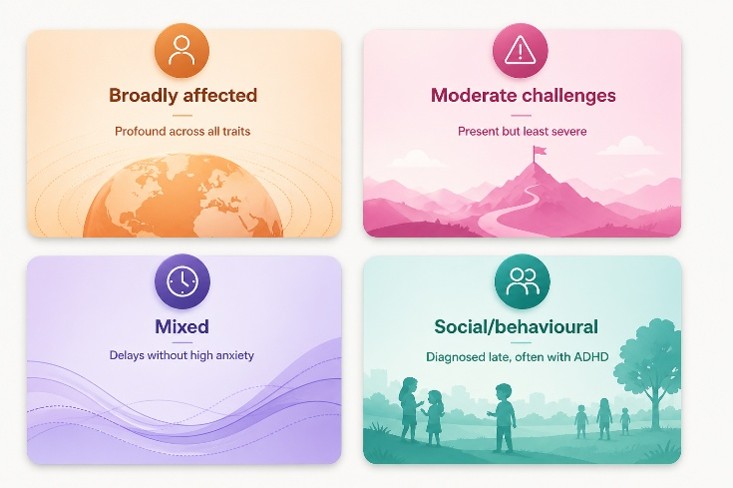
Crucially, these groups didn't just differ behaviourally — they differed genetically.
Not only in which gene variants people carried, but also in when during prenatal and childhood development those genes became active.
A separate study published in Nature in October 2025 corroborated the social/behavioural subgroup as a biologically distinct category.[⁷]
This is the first time we've had reasonably robust evidence that what we currently call "autism" is, at a biological level, several different things wearing the same name.
Genes Tell Part of the Story —But Only Part
Autism is highly heritable — twin studies estimate over 80%.[⁸]
But that doesn't mean a single "autism gene".
About a fifth of autism diagnoses involve rare, high-impact gene variants that affect how brain cells communicate (such as SHANK3 and NLGN3).[¹][⁹] Children with these variants often have additional diagnoses like epilepsy or intellectual disability.
For the majority, the picture is more mosaic-like: many common gene variants each contributing a small effect, which together can cross the autism threshold.
A study of more than 46,000 Danes — about 40% autistic — flagged genes active in brain regions involved in social communication, memory and sensory perception.[¹⁰]
In short: hundreds of genes, thousands of variants, many routes to similar-looking outcomes.
Environment Matters Too
Autism isn't purely genetic. Researchers have found observational links between autism and:
- Maternal fevers during pregnancy (a 2021 meta-analysis of 36 studies).[¹¹]
- Air pollution and hormone-disrupting chemicals, which may damage DNA repair processes in sperm, eggs or the early embryo.[¹²]
- Higher parental age, correlated with more spontaneous mutations in sperm and egg cells.[¹³]
- Valproate exposure in utero — an epilepsy medication now well-established as a cause of autism via epigenetic effects.[¹⁴]
What hasn't been shown is any link between autism and vaccines.
The 1998 Wakefield paper that started the myth was retracted by The Lancet in 2010, and decades of large population studies since have found no causal link.[¹⁵]
Australian families can be reassured on that point.
Proving causation in humans remains genuinely difficult, but the field is investing — including via the US National Institutes of Health's US$50 million Autism Data Science Initiative.[¹⁶]
Why Subtyping Matters
If autism is actually four (or more) different conditions, research that pools all autistic people together washes out signals that would otherwise be obvious.
As Yale epidemiologist Dr Zeyan Liew puts it: "If you can refine your phenotype, you have a better chance of finding the cause."[¹]
That may be why decades of autism research have produced relatively few definitive findings — and why the field is now shifting towards more granular, biologically-informed subtyping.
What This Means for Australian Patients and Families
If you or your child has been diagnosed with autism, none of this changes your diagnosis today.
But it does change the direction of travel for autism care over the next decade.
Autism rarely travels alone.
The "social/behavioural" subgroup commonly co-occurs with ADHD and depression.[⁶] Anxiety, sleep difficulties and sensory sensitivities are common across all subgroups.[¹⁷]
A psychiatric assessment that considers the whole picture is often more useful than one that doesn't.
Knowing the pattern can guide support.
Identifying higher risk of ADHD or mental health concerns can shape decisions around schooling, NDIS plans, therapy choices and, where appropriate, medication — and can mean support is offered earlier rather than after a crisis.
Splitting the spectrum isn't universally welcomed.
Some advocates worry it could increase stigma for those with profound challenges; others worry the opposite, that subtler difficulties will be marginalised.
These concerns are legitimate.
The point of biologically informed subtyping is not to gatekeep support — it's to make it more accurate.
Better biological understanding doesn't replace the need for societal adaptation — schools, workplaces and public spaces that accommodate neurological differences.
It complements it.
What This Means for Australian Clinicians
For GPs, paediatricians, psychiatrists, psychologists and allied health, the implications are practical.
Diagnostic humility.
The DSM-5 ASD label captures a genuinely heterogeneous group. A patient's trajectory is shaped by factors well beyond the diagnosis — comorbidity, language, intellectual capacity, family context and access to support all matter.
Routine comorbidity screening.
If the social/behavioural subgroup is biologically distinct — diagnosed later, frequently with ADHD and depression — then screening for these in autistic patients is good practice, not over-investigation.[⁶][¹⁷]
Equally, autistic traits should be considered in adults presenting with treatment-resistant depression or longstanding ADHD where the developmental history fits.
Medication realism.
No approved medication treats the core features of autism.[¹]
Risperidone is TGA-indicated for short-term symptomatic management of irritability and aggression in autism,[¹⁸] and stimulants and SSRIs have established roles in co-occurring ADHD and mood disorders.
But behavioural, educational and environmental support remains the foundation, in line with RANZCP and NHMRC-endorsed guidance.[¹⁹]
The subtyping research is exciting, but it's early.
Clinical guidelines won't catch up until findings are replicated and translated into validated tools.
In the meantime, the most useful posture is careful, individualised assessment.
Specialist Access and Telehealth in Australia
Geography has always been a problem in Australian healthcare.
Families in regional Victoria, remote WA or northern Queensland may live hours from the nearest psychiatrist or developmental paediatrician — and even metropolitan waitlists can stretch into many months.[²⁰]
Telehealth psychiatry has changed that. Patients can access specialist mental health assessment and care without travelling or waiting for local capacity.
For autistic patients in particular —many of whom find unfamiliar environments genuinely difficult — being able to attend from a familiar space at home can make a real difference to the consultation itself.[²¹]
For autistic adults whose presentations were missed in childhood, telehealth has also been a key route into care for related conditions like ADHD, anxiety and depression — diagnoses that often shape day-to-day functioning more than the underlying autism does.

At Dokotela, our psychiatrists provide telehealth mental health assessment and treatment to patients across Australia, with a GP referral.
We see many patients with autism, ADHD, mood and anxiety disorders, and the comorbidities that travel with them.
Our role isn't to diagnose autism in isolation — that often sits with developmental paediatricians or specialist multidisciplinary teams — but to support the broader mental health picture surrounding an autism diagnosis.
Looking Ahead
The shift from "autism as one condition" to "autism as several" won't happen overnight.
The DSM won't change tomorrow.
NDIS criteria won't be rewritten next year.
But the direction is clear: more granular understanding, more personalised care, better outcomes.
Autism may not be a single condition.
But the people who live with it deserve care that's consistent in one important way — care that takes them seriously as individuals.

References
- The Economist. "Why autism should not be treated as a single condition." Science & Technology section, 3 December 2025. economist.com
- Australian Bureau of Statistics. Disability, Ageing and Carers, Australia: Summary of Findings, 2022 — autism prevalence estimate of 290,900 Australians (approximately 1.1% of the population). ABS, 2024. abs.gov.au
- American Psychiatric Association. Diagnostic and Statistical Manual of Mental Disorders, Third Edition (DSM-III). Washington, DC: APA, 1980.
- American Psychiatric Association. Diagnostic and Statistical Manual of Mental Disorders, Fourth Edition (DSM-IV). Washington, DC: APA, 1994.
- American Psychiatric Association. Diagnostic and Statistical Manual of Mental Disorders, Fifth Edition (DSM-5). Arlington, VA: APA, 2013.
- Litman A, Sauerwald N, Snyder M H, et al. "Decomposition of phenotypic heterogeneity in autism reveals underlying genetic programs." Nature Genetics, July 2025. (Princeton University / Flatiron Institute collaboration identifying four ASD subgroups, as reported in The Economist, 3 Dec 2025.)
- Corroborating study on the social/behavioural autism subgroup. Nature, October 2025. (As reported in The Economist, 3 December 2025 — readers should refer to the original publication for full citation.)
- Tick B, Bolton P, Happé F, Rutter M, Rijsdijk F. "Heritability of autism spectrum disorders: a meta-analysis of twin studies." Journal of Child Psychology and Psychiatry, 2016; 57(5): 585–595.
- Bourgeron T. "Current knowledge on the genetics of autism and propositions for future research." Comptes Rendus Biologies, 2016; 339(7-8): 300–307. (Foundational work on SHANK3, NLGN3 and synaptic gene variants in autism.)
- Grove J, Ripke S, Als T D, et al. "Identification of common genetic risk variants for autism spectrum disorder." Nature Genetics, 2019; 51(3): 431–444. (Danish iPSYCH cohort, with subsequent extensions cited in The Economist.)
- Antoun S, Ellul P, Peyre H, Acquaviva E, et al. "Fever during pregnancy as a risk factor for neurodevelopmental disorders: results from a systematic review and meta-analysis." Molecular Autism, 2021; 12: 60.
- Volk H E, Lurmann F, Penfold B, Hertz-Picciotto I, McConnell R. "Traffic-related air pollution, particulate matter, and autism." JAMA Psychiatry, 2013; 70(1): 71–77. See also review in Molecular Psychiatry, 2022, on environmental contributions to autism risk (cited in The Economist).
- Sandin S, Schendel D, Magnusson P, et al. "Autism risk associated with parental age and with increasing difference in age between the parents." Molecular Psychiatry, 2016; 21(5): 693–700.
- Christensen J, Grønborg T K, Sørensen M J, et al. "Prenatal valproate exposure and risk of autism spectrum disorders and childhood autism." JAMA, 2013; 309(16): 1696–1703. See also: Therapeutic Goods Administration, valproate safety advisory: tga.gov.au
- Wakefield A J, et al. "Ileal-lymphoid-nodular hyperplasia, non-specific colitis, and pervasive developmental disorder in children." The Lancet, 1998 — RETRACTED, 2010. For the contemporary evidence base, see: Hviid A, Hansen J V, Frisch M, Melbye M. "Measles, Mumps, Rubella Vaccination and Autism: A Nationwide Cohort Study." Annals of Internal Medicine, 2019; 170(8): 513–520.
- National Institutes of Health. Autism Data Science Initiative (ADSI), announced 2025. nih.gov
- Lai M-C, Kassee C, Besney R, et al. "Prevalence of co-occurring mental health diagnoses in the autism population: a systematic review and meta-analysis." The Lancet Psychiatry, 2019; 6(10): 819–829.
- Therapeutic Goods Administration. Australian Product Information — Risperidone. TGA, current edition. tga.gov.au
- Whitehouse A J O, Evans K, Eapen V, Wray J. A national guideline for the assessment and diagnosis of autism spectrum disorders in Australia. Cooperative Research Centre for Living with Autism (Autism CRC), 2018 — endorsed by NHMRC. See also: Royal Australian and New Zealand College of Psychiatrists, position statements on autism spectrum disorder, ranzcp.org
- Royal Australian and New Zealand College of Psychiatrists. Keeping your head above water: Affordability as a barrier to mental health care. RANZCP, 2022. ranzcp.org
- Snoswell C L, Chelberg G, De Guzman K R, et al. "The clinical effectiveness of telehealth: A systematic review of meta-analyses from 2010 to 2019." Journal of Telemedicine and Telecare, 2023; 29(9): 669–684.
About the author / clinical review note
This article was prepared for Dokotela's blog as a general educational resource for patients, families and Australian healthcare professionals.
It is not a substitute for individual medical advice. If you are concerned about autism, ADHD or mental health for yourself or someone in your care, speak with your GP about a referral.

Who Can Diagnose and Prescribe ADHD Medication in Australia?
GP, psychologist, paediatrician or psychiatrist? A plain-language guide to who does what in adult ADHD assessment and prescribing in Australia — and the questions to ask before you book.
Who Can Diagnose and Prescribe ADHD Medication in Australia?Child & Adolescent Psychiatry: Essential Guidance for Parents
Decoding the World of a Child & Adolescent Psychiatrist: What Parents Need to Know Every child’s mental well-being is of utmost importance, and as parents.
Child & Adolescent Psychiatry: Essential Guidance for Parents


